1. The High-Latitude Solar Reality
In Oslo, Bergen, and inland mountain valleys, peak solar insolation drops from 5.5 kWh/m²/day in June down to less than 0.4 kWh/m²/day in December. Designing a pure off-grid cabin means planning for this massive seasonal variance. While summer offers nearly 20 hours of daylight generating surplus power, November through January requires strict conservation and hybrid integration.
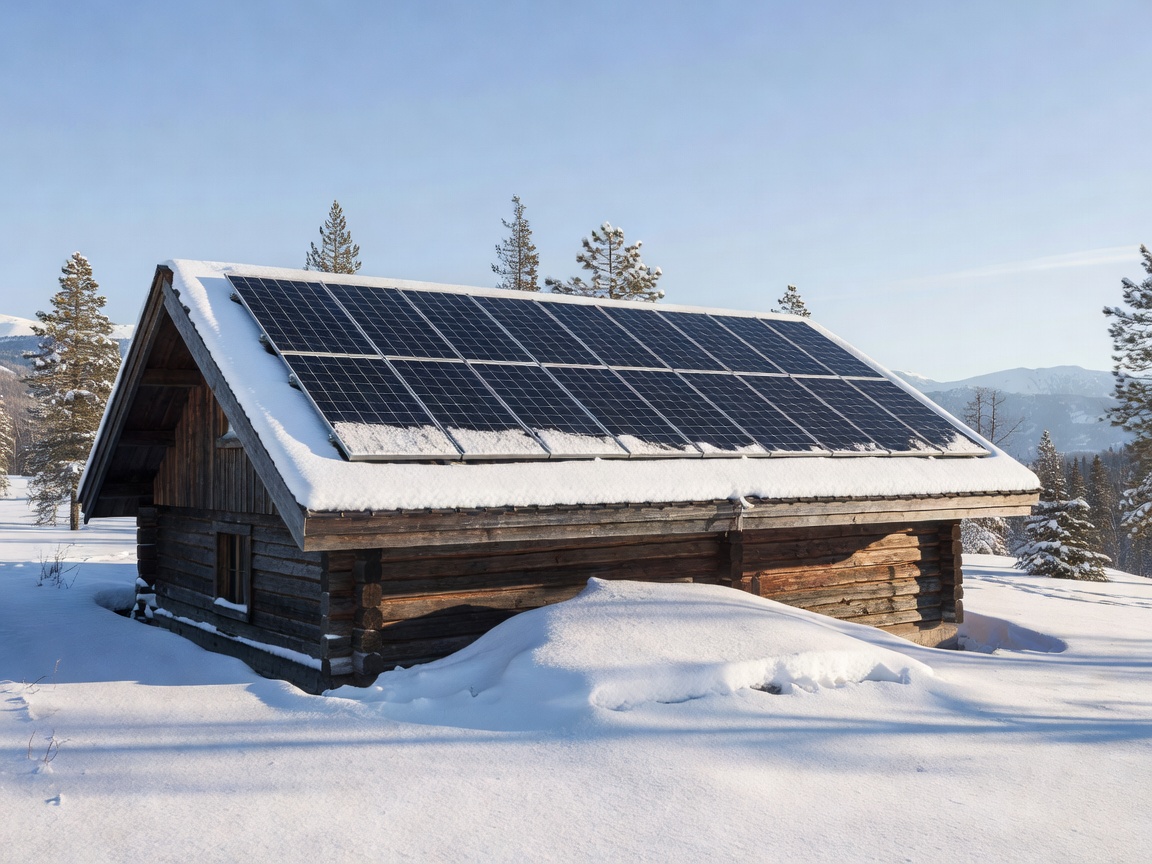
To optimize winter yield, solar panels must be mounted at a steep 60° to 70° tilt angle on south-facing gables or walls rather than flat on roofs. At 65°, snow slides off immediately when the glass warms slightly, and the panels capture the low-angle winter sun alongside intense reflective albedo from surrounding snow fields.
Recommended Off-Grid System Specifications (30–45 m² Cabin)
- Photovoltaic Array: 4x 400W Monocrystalline PERC modules (1.6 kWp total).
- Charge Controller: 150V / 60A Maximum Power Point Tracking (MPPT) regulator.
- Battery Bank: 24V or 48V Lithium Iron Phosphate (LiFePO4) 200Ah (~5.1 kWh storage).
- Inverter/Charger: 24V to 230V Pure Sine Wave 3000VA with generator auto-start relay.
- Backup Auxiliary: 2.0 kW inverter generator running on alkylate fuel or propane.
2. LiFePO4 Battery Chemistry in Freezing Temperatures
Lithium Iron Phosphate (LiFePO4) batteries provide superior cycle life (over 3,500 cycles at 80% DoD) and high energy density compared to traditional lead-acid or AGM banks. However, LiFePO4 cells cannot be charged below 0°C (32°F). Forcing charge current into frozen lithium cells causes permanent metallic lithium plating on the anodes, destroying the cells and posing a safety hazard.
To solve this in an unheated weekend cabin, builders must implement a multi-stage battery strategy:
- Internal Heated Cell Blankets: Using battery packs equipped with built-in silicone heating pads that divert initial solar incoming current to warm the pack above +5°C before the internal Battery Management System (BMS) permits charge current.
- Insulated Thermal Enclosure: Housing the batteries in an insulated XPS (extruded polystyrene) cooler box placed near the cabin interior floor or wood stove area.
- Low-Temperature BMS Cutoff: Ensuring your solar charge controller and BMS feature hardware temperature sensor probes with automatic charge cut-off set at +2°C.
3. Water Management: Frost-Free Supply and Drainage
Leaving water sitting in copper or PEX pipes inside an unheated winter cabin will burst plumbing lines within 48 hours of departure. Scandinavian DIY cabins implement two primary strategies for water:
| Plumbing Strategy | Methodology | Departure Protocol | Greywater Treatment |
|---|---|---|---|
| Dry Carry-In & Foot Pump | 20L food-grade jerrycans connected to a manual whale foot pump at the sink | Zero minutes (empty canister and carry out) | Direct drain to an exterior insulated infiltration ditch |
| PEX Gravity-Drain System | Pressurized 12V RV pump drawing from an interior 100L tank | Open low-point drain valves; blow out taps with compressor | Percolation bed with EPS frost insulation skirts |
Sloping Greywater Waste Lines
Sink and shower waste lines must exit the building at a steep 1:30 fall and immediately enter an insulated, unvented drain pipe. Any horizontal flat run outside the insulated building envelope will accumulate water trickles that freeze in layers until the line is completely choked with solid ice.
4. Off-Grid Lighting and 24V vs. 230V Distribution
Running an inverter 24/7 to power standard 230V household electronics consumes between 25W and 45W in idle self-consumption, which drains up to 1 kWh per day just keeping the inverter awake.
High-efficiency Nordic cabin electrical plans separate circuits: high-efficiency LED puck lighting, USB-C fast charging stations, and water pumps run on a native 24V DC bus directly from the battery bank without inverter losses. The large 230V AC inverter is switched on via remote relay only when running power tools, induction cooktops, or vacuum cleaners.