1. The Physics of Airtightness vs. Combustion Demand
Older traditional log cabins were naturally leaky; drafts through corner joints and floorboards supplied hundreds of cubic meters of fresh air to open fireplaces. Modern DIY timber cabins, conversely, are wrapped in taped polyethylene membranes and wind barriers to eliminate thermal loss.
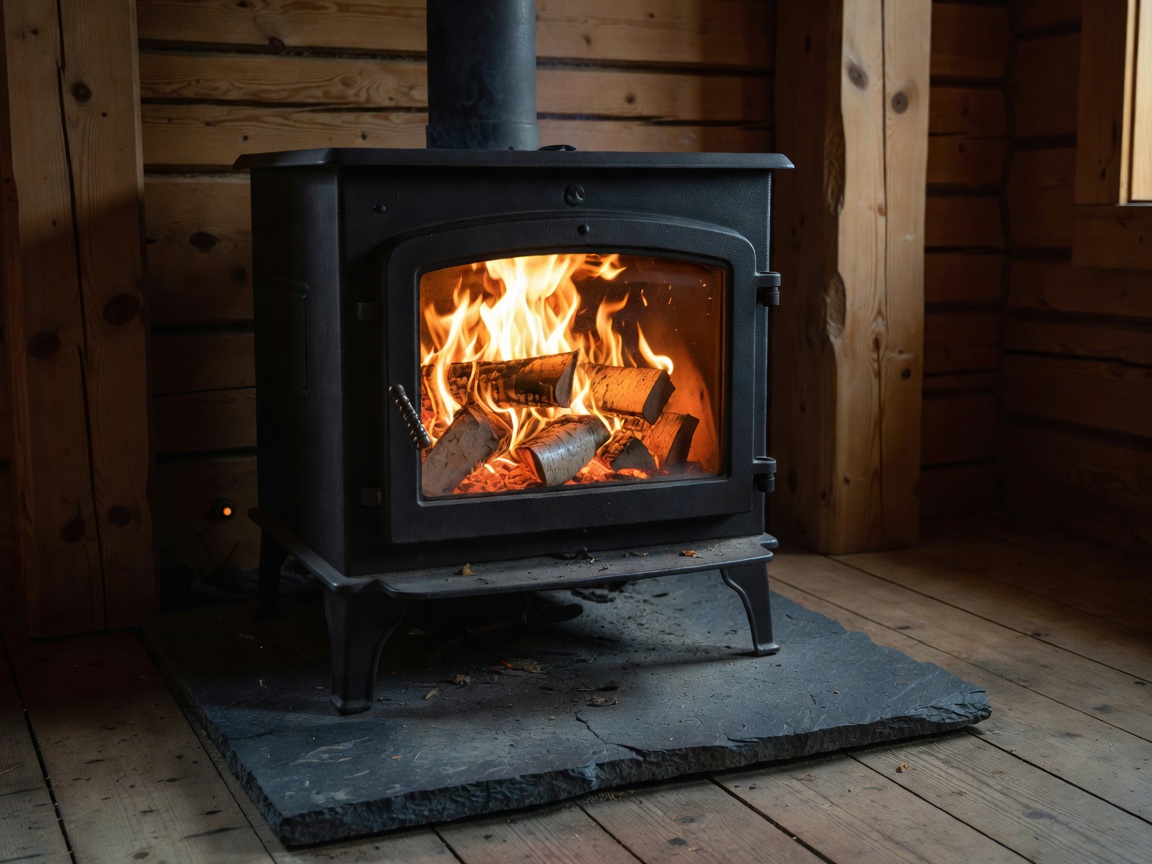
A standard 5 kW wood stove requires approximately 15 to 25 m³ of fresh air per hour to support clean combustion. In a 35 m² cabin with a 2.4m ceiling height, the total interior volume is only 84 m³. Without dedicated external supply, operating the stove quickly creates negative interior air pressure. This slows the chimney draught, spills toxic carbon monoxide into the sleeping space, and starves the fire.
The Non-Negotiable Direct Air Intake Rule
Always select a stove model equipped with a sealed external air connection (tilluft) on the rear or underside. Route a 100mm galvanized spiral pipe directly from the stove through the floor or exterior wall to the outdoors. Insulate this duct with 25mm foil-faced mineral wool to prevent interior condensation from forming on the ice-cold steel pipe.
2. Sizing the Stove for Compact Living
One of the most common errors in cabin design is over-sizing the wood stove. Installing an 8 kW or 10 kW stove in a well-insulated 35 m² space will make the cabin uncomfortably hot (often exceeding 30°C within an hour). Owners are then forced to close the air dampers to choke the fire.
Choking a fire creates incomplete combustion, coating the chimney with highly flammable creosote and releasing black soot into the atmosphere. For cabins between 25 m² and 50 m², an appliance with a nominal output of 3.5 kW to 5.0 kW featuring secondary air injection (clean-burn technology) is optimal.
| Stove Class | Nominal Heat Output | Ideal Cabin BYA | Fuel Efficiency | Thermal Mass Behavior |
|---|---|---|---|---|
| Cast Iron Clean-Burn | 4.0 – 5.0 kW | 25 – 45 m² | 78% – 82% | Fast radiant heatup; cool down in 2–3 hours |
| Soapstone Clad (Kleberstein) | 4.5 – 6.0 kW | 35 – 60 m² | 80% – 85% | Slow initial heatup; radiates gentle heat for 8+ hours |
| Pellet Stove (Off-Grid 12V) | 3.0 – 6.0 kW | 30 – 70 m² | 85% – 90% | Thermostat automated; requires steady DC power |
3. Chimney Dynamics and Fire Separation Distances
To maintain dependable draft even during cold inversions, the chimney height should be a minimum of 3.5 to 4.0 meters from the stove collar to the cowl. The top of the chimney must terminate at least 0.8 meters above the roof ridge, or 1.5 meters from any roof surface on steeper slopes, ensuring turbulent winds bouncing off the roof peak do not push exhaust gases backward down the flue.
Where the insulated stainless-steel twin-wall chimney passes through the ceiling and timber roof deck, Norwegian fire codes mandate a minimum clearance of 50 mm from outer chimney casing to combustible wood materials, with the annular space filled with non-combustible A1-rated rockwool insulation.
4. Passive Gravity Ventilation Strategy
When the stove is idle during sleep or unoccupied periods, how does fresh air cycle through the building without mechanical power? Scandinavian cabins use passive displacement ventilation:
- Low Level Fresh-Air Vents: Adjustable disc valves (100mm) placed low on the windward wall, introducing dense, cool oxygen-rich air.
- High Level Exhaust Vents: Adjustable disc valves installed on the leeward gable wall near the highest ceiling point, allowing stale warm air, moisture, and CO2 to exhaust naturally via stack effect.
- Trickle Vents in Window Frames: For continuous acoustic-damped baseline air exchange.